How Does Wiped Film Evaporation Work in Used Oil Re-Refining?

Author: Mr. JAY
Senior Petrochemical & Used Oil Recycling Engineer
With practical experience in used oil recycling systems, fuel recovery routes, and industrial optimization, he focuses on converting waste hydrocarbon streams into cleaner and more valuable products.
During used oil re-refining, separating recoverable oil fractions from heavier non-volatile components is an important part of the distillation process. However, some feedstocks contain highly viscous components or substances that are sensitive to prolonged heating. However, some feedstocks contain highly viscous fractions and substances susceptible to prolonged heating.
Wiped film evaporation is one of the alternative methods for processing such feedstocks. The evaporation of oil in a thin film on a hot surface and in a vacuum allows for effective heat and mass exchange with minimum thermal treatment duration.
But how does the wiped film evaporator work, what issues can it solve, and in what cases is it worth using during the construction of used oil re-refining facilities?
Why Is Wiped Film Evaporation Used in Used Oil Re-Refining?
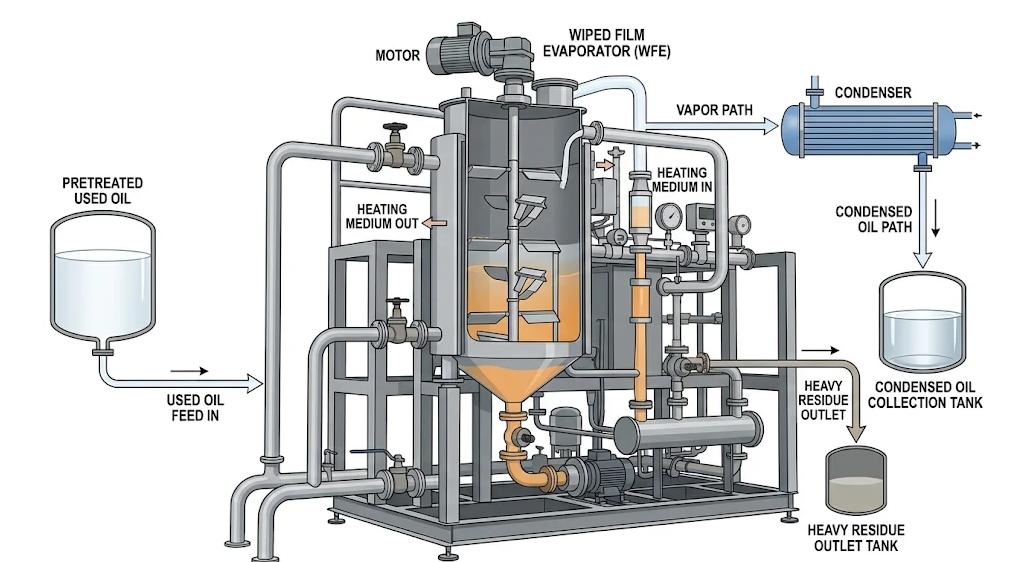
However, even after the pretreatment process, the lubricating oil still comprises various oil fractions and heavy components that should be separated. The distillation process should ensure the recovery of valuable oil fractions with minimal thermal exposure.
In some cases, conventional heating and evaporation techniques can cause problems in the processing of certain materials characterized by high viscosity and sensitivity to heat. In order to overcome these limitations, wiped film evaporation can be used.
The primary advantages of this method are:
- Reduced thermal exposure: Relatively short residence times help reduce the risk of thermal degradation.
- Enhanced heat transfer: Thin and continuously renewed film of oil allows good contact with the heated surface.
- Vacuum operation: Lower operating pressure ensures evaporation at lower temperatures compared to other processes.
- Discharge of heavy residues: The design of the apparatus allows for continuous discharge of non-evaporable heavy materials.
Therefore, wiped film evaporation can be applied in some waste oil re-refining operations.
How Does a Wiped Film Evaporator Process Used Oil?
The wiped film evaporator is the process by which volatile oil fractions are separated from non-volatile components in three main stages. To understand how this equipment fits into the overall re-refining process, read our guide to the Used Oil Distillation Process.
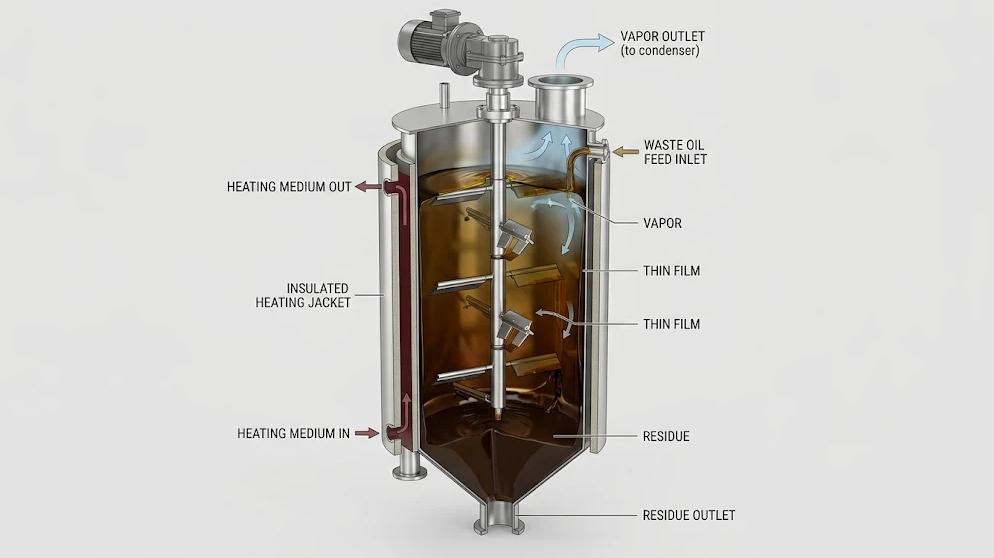
Cutaway illustration of a wiped film evaporator showing the rotating wipers and oil separation process
1. Oil Is Spread into a Thin Film
The pretreated oil is fed into the evaporator using the feed distribution mechanism. In the evaporator, there is a rotating mechanism fitted with wiper blades.
The oil is not retained in the evaporator as a deep liquid, but rather spread in the form of a thin film due to the rotational wiper blades.
The use of the thin film allows for good contact between the heated surface and the oil. This is especially helpful when working with viscous oils.
2. Heat and Vacuum Separate the Oil Components
Heat is supplied to the evaporator via its wall to the thin film of oil. Meanwhile, the vacuum system lowers the pressure in the equipment.
The lower pressure means that the temperature necessary for vaporization of the component is decreased. As the oil film passes along the heated wall, components with suitable volatility evaporate from the liquid.
Thus, due to the presence of the thin film, heating, and vacuum conditions, evaporation takes place over a relatively short residence time.
Operating temperatures, vacuum, and residence times depend on the composition of the feedstock and the required results of the process.
3. Recovered Vapors and Heavy Residues Leave Separately
The vapors will depart from the remaining liquid and go into the vapor recovery and condensation system.
The condensed liquid can be collected as a recovered oil fraction and transferred to the next processing stage. Further refining may be required to meet the target base oil specifications. However, the heavier liquid will remain in the evaporator and will be removed through the residue outlet.
In total, there will be two different streams: one is the recoverable oil fraction, and the other is the residue stream.
It should be noted that the recovered oil is not always the final base oil. Additional processing is needed to get a better-quality product.
What Problems Can Wiped Film Evaporation Help Solve?
The value of a wiped film evaporator is determined by the issues that are present within a specific refining process.
- Overheating: There are some oil fractions that degrade due to overheating during processing. The shorter residence time of the wiped film evaporation process reduces the duration of thermal impact.
- High viscosity of feedstock: A viscous oil can be hard to spread evenly over the heating surface. The rotating wipers continuously spread and renew the oil film across the heated surface, helping maintain effective contact between the feed and the heating wall.
- Residue management: Used oil can contain residues that are left behind after the distillation of the target oil fractions. Proper design of the residue discharge system helps to get rid of the residues.
- Vacuum-based separation: When oil fractions need to be separated under reduced pressure, a wiped film evaporator can combine vacuum operation with thin-film evaporation. This arrangement can be useful when the feedstock and separation requirements justify its use.
Nevertheless, this does not mean that every used oil re-refining plant should have a wiped film evaporator.
When Should You Choose Wiped Film Evaporation?
It is necessary to choose a wiped film evaporator according to process needs and not only for its advanced evaporation capability.
These aspects must be considered before incorporating wiped-film evaporation in the re-refining of a waste oil plant:
- Feedstock characteristics: Properties like viscosity, heavies, water, and undesired light fraction affect the distillation scheme.
- Pretreatment: Water, solids, and unwanted light fractions need to be removed by means of pretreatment prior to distillation.
- Throughput: Capacity and continuous operations need to be accounted for when designing the process.
- Product specification: Distillate fractions and further refining processes determine the most suitable distillation process.
- Operational and maintenance considerations: Vacuum, heat transfer, rotor design, and residue discharge are interrelated and should be considered together.
In some cases, wiped film distillation may have some advantages. In other cases, batch or continuous distillation may be more suitable.
This choice should therefore be made according to the entire process design, not based on the equipment performance alone.
Wiped Film Evaporation vs. Other Distillation Options
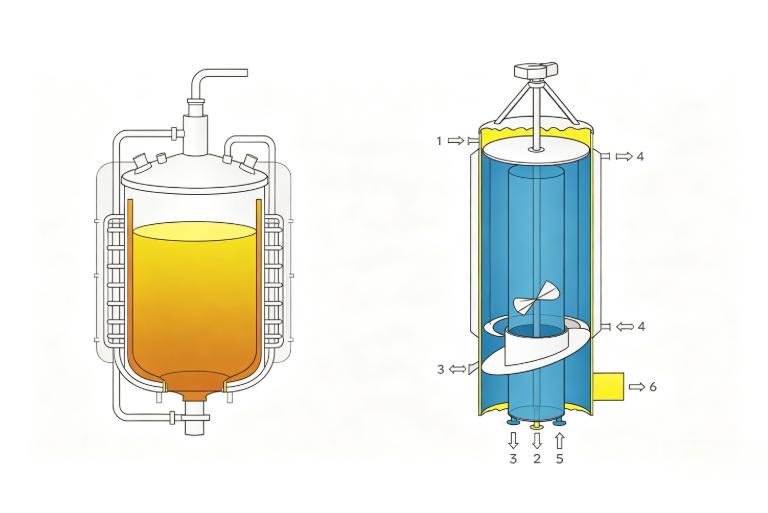
The waste oil re-refinery may employ different distillation arrangements based on the operational requirements. Three types of such distillation arrangements are batch distillation, continuous distillation, and thin-film distillation.
| Distillation option | Main characteristics | Key selection considerations |
| Batch distillation | Processes oil in separate batches | Operating flexibility and batch requirements |
| Continuous distillation | Processes feed continuously through the system | Throughput and continuous operation |
| Thin-film distillation | Uses a mechanically renewed thin film for evaporation | Feedstock properties and separation requirements |
These alternatives cannot be interchanged across all applications.
The batch and continuous distillations refer to different operational modes, while the thin-film distillation refers to a certain type of evaporation technology.
How Does VBOLT Configure a Waste Oil to Base Oil Plant?
Each used oil re-refining project has its own characteristics of feedstocks, capacities, and target base oil specifications. This is why the distillation layout must be chosen based on each individual project, rather than using the same equipment layout for all plants.
VBOLT provides various layouts for its Waste Oil to Base Oil Plant, which include batch, continuous, and thin-film distillation systems. The thin-film distillation system is an optional configuration that may be used depending on feedstock properties and process conditions.
Get to know more about our Waste Oil to Base Oil Solution and find out a suitable distillation layout for your used oil re-refining project.