Used Oil Distillation Process: From Pretreatment to Oil Recovery

Author: Mr. JAY
Senior Petrochemical & Used Oil Recycling Engineer
With practical experience in used oil recycling systems, fuel recovery routes, and industrial optimization, he focuses on converting waste hydrocarbon streams into cleaner and more valuable products.
Used oil has hydrocarbon elements of high value that can be effectively recovered via an appropriate distillation technology. Raw used oil cannot be directly introduced to the distillation plant because water, solid particles, light hydrocarbons, and degradation products can have an impact on heat transfer, stability, and the quality of recovered oil.
An industrial process of used oil distillation normally includes pre-treatment of the feedstock, dehydration, heating under certain pressure, distillation under vacuum, condensation, and collection of oil fractions. The particular scheme of the process is determined by the properties of the initial oil and the recovered products.
Knowledge of the process stages allows for evaluation of equipment needed for effective oil recovery.
Why Does Used Oil Need Pretreatment Before Distillation?
Used oil from engine systems, industrial machinery, and other lubrication systems may be contaminated with different substances that have accumulated during use and collection. These impurities should be removed before distillation.
These impurities may be:
- Water: Free water and emulsified water can affect the energy input for heating and cause unstable operation.
- Suspension of solids: Metal particles, carbon deposits, dust, and sludge can cause blockages, fouling, and wear of equipment.
- Light hydrocarbons: Fuel residues and other light impurities can influence the vapor formation and separation process.
- Degradation products: Oxidation products and other impurities formed during oil service can affect the properties of the fractions obtained.
Pretreatment lowers the amount of impurities entering the distillation process. Also, this procedure protects the equipment used further and provides a more stable feed.
The extent of pretreatment depends on the composition of the feedstock. Oil containing large amounts of water or heavy sludge may require a more intensive pretreatment than collected lubricating oil.
What Are the Main Pretreatment Steps in Used Oil Distillation?
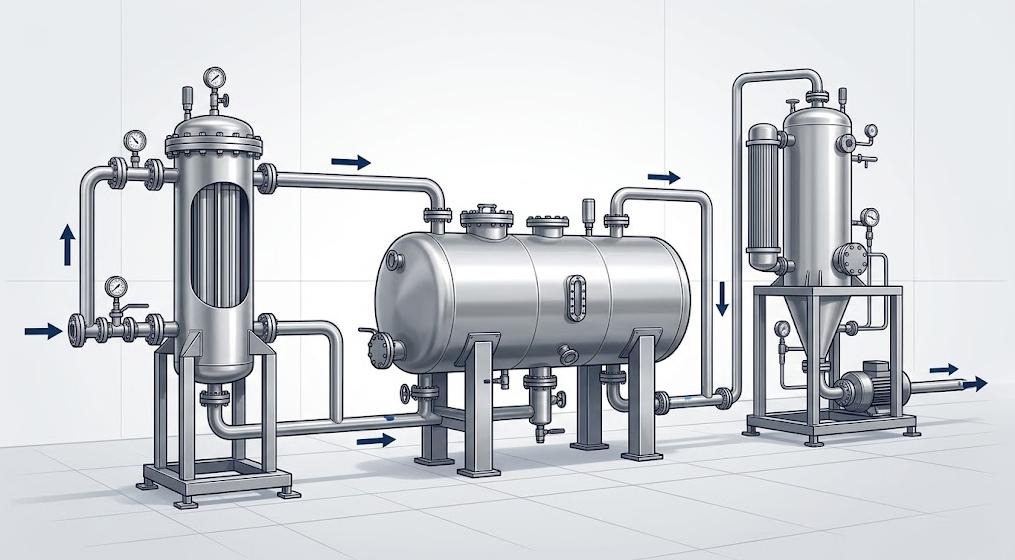
Pretreatment normally comprises solid separation, liquid separation, and conditioning of the feed. The pretreatment allows the used oil to be heated under control and subjected to distillation.
Feedstock Filtration and Solid Separation
The first step is normally filtration or some other solid-liquid separation equipment.
The system can have coarse filtration, fine filtration, settling tanks, or other separation equipment depending on the feedstock. Large particles and sludge are separated from the oil before its entry into the process equipment.
Solid separation is very important to reduce fouling in heat exchangers, pipelines, evaporators, and distillation equipment. Filter selection should take into account the particle size distribution, sludge content, and viscosity of the feed.
Dehydration and Water Separation
The separation of water is critical to the pretreatment of waste oils. The waste oil collected may have free water due to its storage and transportation, as well as emulsified water mixed within the oil.
Free water could be easily separated using the process of settling and separation equipment. Further dehydration using heating or even a vacuum process may be necessary for feedstock that carries hard-to-remove water content.
The separation of water before distillation prevents extra heat load and operating disturbances due to water vapor.
Light Ends Removal and Feed Conditioning
Some used oils have gasoline-range compounds, fuel components, and other light-boiling compounds. Sometimes the light-boiling compounds have to be separated in a special step prior to the extraction of the oil fraction.
Light ends removal is achieved by means of heating and subsequent vaporization using the right process conditions. Then, the separated vapors are further subjected to condensation.
Following pretreatment, the feedstock may be heated and transferred to the distillation section in a controlled manner. The process sequence will depend on the chosen process design.
How Does the Used Oil Distillation Process Work?
Following pretreatment, the conditioned oil is charged into the distillation process. The aim here is to obtain different hydrocarbons by utilizing differences in their volatility and boiling points.
In the case of many used oil re-refining processes, vacuum distillation is used to distill out lubricating oil fractions without reaching high temperatures that would be necessary if distillation were done at atmospheric pressure.
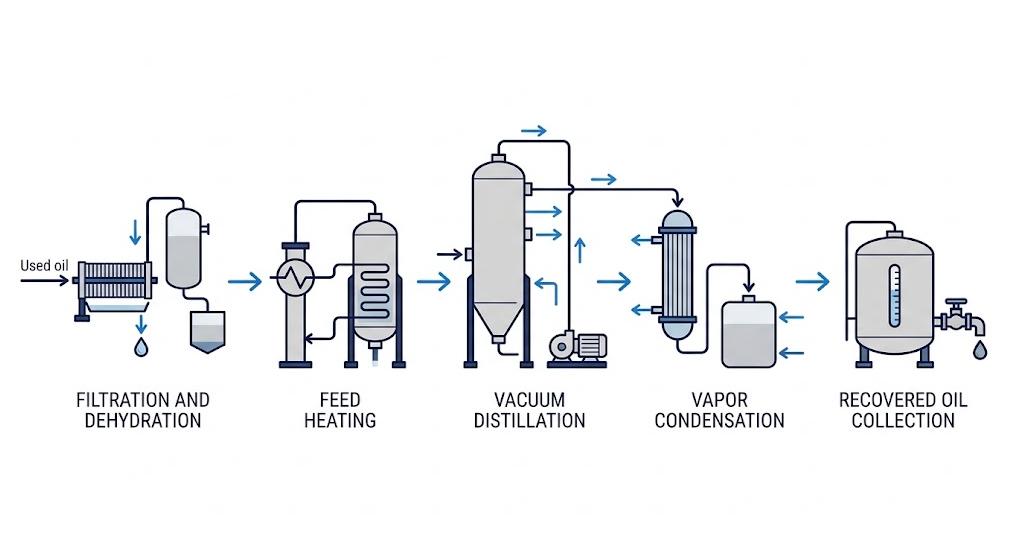
Heating and Vaporization
Pretreated oil is heated to reach the required temperature for the chosen distillation process. Feedstock may be heated in heat exchangers and process heaters to reach the required processing conditions.
During heating, various components start to vaporize due to their different boiling points.
Heating must be controlled. Overheating may cause decomposition and other undesirable changes in the oil.
The design of the heating process depends on the feedstock properties, throughput, and separation process downstream.
Vacuum Distillation and Oil Fractions Separation
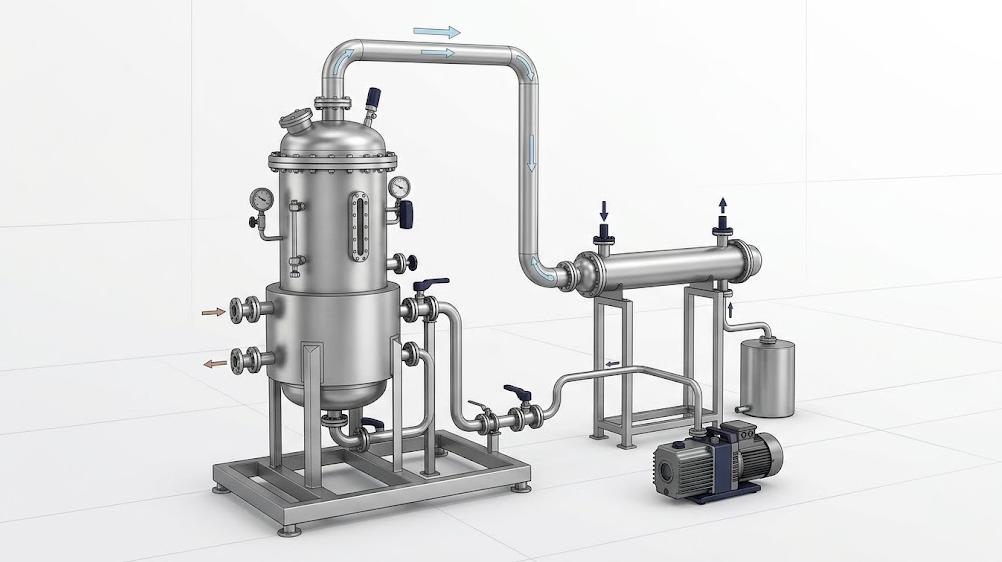
Vacuum distillation is commonly applied in used oil re-refining processes, as lowering the pressure leads to lower boiling points of oil components.
This way, the fractions with higher boiling points can be vaporized and separated in a more controllable manner. It will also help to minimize the risks of thermal degradation while processing the oil.
Depending on the specific design of the plant, the distillation unit may include vacuum distillation vessels, columns, or thin film evaporation units.
The thin film evaporator spreads the heated oil into a thin liquid layer on the surface that is heated. This will provide efficient heat transfer and reduced thermal residence time. This makes thin film evaporation appropriate for some high-viscosity oils.
But not all used oil distillation plants require thin film evaporation units. The choice of the equipment depends on the specifics of the process.
Condensation and Oil Recovery
The oil vapors, after vaporization and separation, move into the condensation process. Heat is extracted from the vapors for them to revert back to the liquid form.
The oil obtained through condensation is collected in specific receivers or tanks. The different fractions can be collected separately depending on the processing setup and the desired specifications.
Further treatments of the recovered fractions, such as filtration, solvent extraction, or adsorption treatments, can be carried out if needed.
The distillation process is thus responsible for the major separation and recovery process, while further processing determines the suitability of the recovered oil as base oil.
Learn more about our Waste Oil to Base Oil Plant to explore the equipment configuration for recovering oil fractions from used oil.
What Products and Residues Are Obtained After Distillation?
The output products of used oil distillation depend on the initial stock and the configuration of the process. A conventional setup will yield several products.
- Oil fractions reclaimed: These will include the primary hydrocarbons separated using distillation and condensation. The qualities of the fractions will depend on the initial oil feed and separation.
- Light fractions: Other lower boiling point constituents may also be recovered in light fractions.
- Residue of distillation: Other heavier fractions, contaminants, degradation products, and residues will also stay behind at the bottom of the vessel.
Recovered oil fractions do not automatically become finished base oils. There is usually still a need for further processing and treatment to enhance their qualities.
In the case of production of base oil, there is the need to treat the fractions in such a way that qualities like color, oxidation stability, viscosity qualities among others are enhanced.
What Factors Affect Used Oil Distillation Efficiency?
The performance of a used oil distillation plant is influenced by several interconnected factors.
Feedstock quality: Water content, viscosity, sludge, suspended solids, and the composition of the oil determine the pretreatment requirements and affect downstream operation.
Operating pressure: Vacuum conditions influence the boiling temperatures of the oil components and the separation performance of the distillation system.
Temperature control: Heating conditions must be sufficient for the required vaporization while avoiding excessive thermal exposure.
Thermal residence time: Long exposure to high temperatures may increase the risk of thermal degradation and deposit formation. Equipment design should provide suitable heat transfer and residence time.
Heat transfer efficiency: Heating surfaces, heat exchangers, and evaporator configurations influence energy consumption and process stability.
Equipment configuration: The selection of distillation vessels, columns, thin-film evaporators, condensers, vacuum systems, and auxiliary equipment should match the feedstock and production targets.
For this reason, a suitable distillation process should be selected based on feedstock analysis and product requirements rather than processing capacity alone.
Used Oil Distillation Plant Solutions
An industrial used oil distillation plant consists of pretreatment, heating, separation, condensation, and product collection systems, all integrated into one process system. The layout of such a plant needs to be planned according to the properties of the oil coming in, its capacity, and the desired specifications of the recovered oil.
VBOLT offers industrial waste oil re-refining plants with process layouts designed based on the specific conditions of the feedstock and project requirements.
For your specific project requirements, please visit our Waste Oil to Base Oil Engineering Solution page or contact us.