
What Is the Difference Between a Refinery and a Petrochemical Plant?

Author: Mr. JAY
Senior Petrochemical & Used Oil Recycling Engineer
With practical experience in used oil recycling systems, fuel recovery routes, and industrial optimization, he focuses on converting waste hydrocarbon streams into cleaner and more valuable products.
In the modern energy and chemical industries, an oil refinery acts as the upstream partner to a downstream petrochemical plant. When raw crude oil arrives at a refinery, it undergoes primary processing to create a wide variety of refined products. A significant portion of these products then flows directly downstream into petrochemical plants for deep manufacturing.
Because these massive facilities are often located in the same industrial complex, they are easy to confuse. However, the simplest way to distinguish a refinery from a petrochemical plant is by looking at the end use of their products:
- Refineries produce fuels to burn: They refine crude oil into energy products like gasoline, diesel, jet fuel, Liquefied Petroleum Gas (LPG), lubricating oils, and asphalt.
- Petrochemical plants produce materials to build: They convert hydrocarbon feedstocks into synthetic building blocks for plastics, synthetic rubber, fibers, and everyday chemical products.
What Is a Refinery Plant?
An oil refinery is a large-scale industrial processing facility that transforms raw, unrefined crude oil extracted from deep underground into usable consumer and industrial fuels.
What Does It Do?
- Separation: Uses high-temperature distillation columns to split heavy crude oil into distinct fractions based on boiling points.
- Conversion (Cracking): Breaks down heavy, low-value hydrocarbons into lighter, high-demand molecules using heat, pressure, and catalysts.
- Treatment (Purification): Removes impurities like sulfur and heavy metals (via hydrotreating) to produce clean-burning fuels that meet environmental standards.
- Blending: Mixes various hydrocarbon streams to meet strict commercial and quality standards (such as octane ratings for gasoline).
What Does It Produce?
- Transportation Fuels: Gasoline, diesel, and jet fuel (kerosene).
- Energy & Heating: Liquefied Petroleum Gas (LPG).
- Infrastructure & Machinery: Asphalt (for paving roads) and lubricating oils.
- Chemical Feedstocks: Naphtha and light gases sent downstream to chemical plants.
What Is a Petrochemical Plant?
A petrochemical plant is an industrial manufacturing facility that converts hydrocarbon feedstocks—typically sourced from oil refineries or natural gas processing plants—into chemical precursors, polymers, and synthetic materials.
What Does It Do?
- Steam Cracking: High-temperature thermal cracking breaks light hydrocarbons (like ethane, propane, or naphtha) into reactive gases such as ethylene and propylene.
- Polymerization: Links small chemical molecules (monomers) together into long molecular chains (polymers) like plastics.
- Synthesis & Purification: Executes complex chemical reactions, aromatics extraction, and high-precision purification to achieve chemical-grade purity.
What Does It Produce?
- Basic Chemical Building Blocks: Ethylene, propylene, butadiene, and aromatics (benzene, toluene, xylenes).
- Plastics & Polymers: Polyethylene (PE), polypropylene (PP), and polystyrene.
- Synthetic Materials: Synthetic rubber (for tires and footwear) and synthetic fibers (such as polyester and nylon).
- Industrial & Consumer Chemicals: Solvents, detergents, fertilizers, and chemical intermediates.
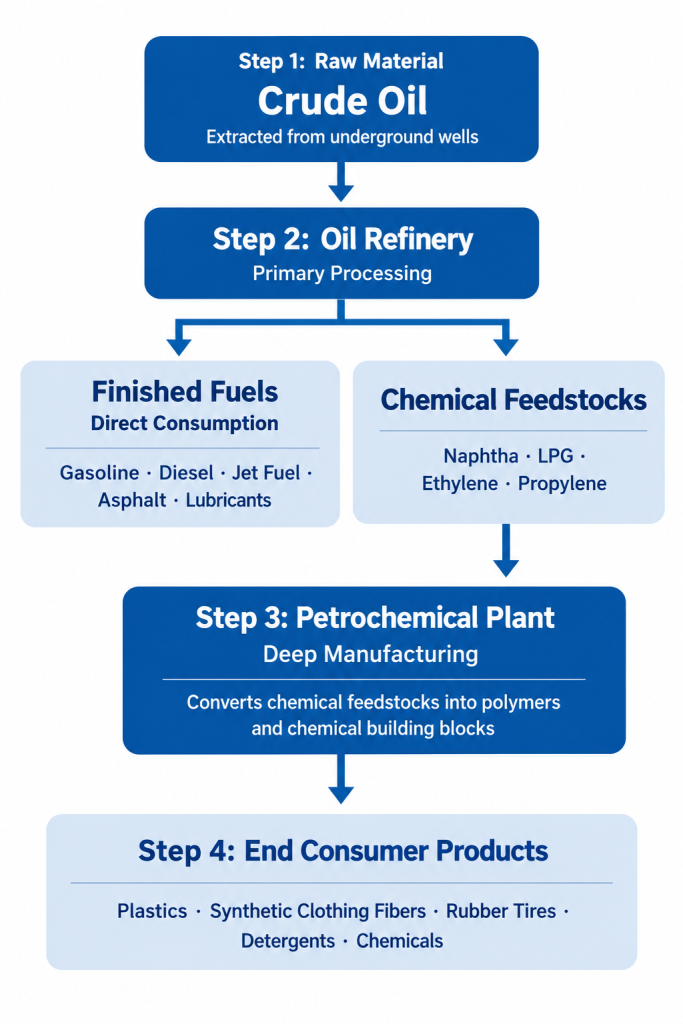
How a Refinery and Petrochemical Plant Work Together
Refineries and petrochemical plants represent adjacent links in the hydrocarbon value chain. The refinery operates upstream/midstream, while the petrochemical plant operates further downstream.
Step 1: Raw Material
Crude oil is extracted from underground wells.
Step 2: Oil Refinery (Primary Processing)
Converts crude oil into:
- Finished Fuels: Gasoline, diesel, jet fuel, asphalt, and lubricants
- Chemical Feedstocks: Naphtha, LPG, ethylene, and propylene
Step 3: Petrochemical Plant (Deep Manufacturing)
Takes chemical feedstocks from the refinery and processes them into polymers and chemical building blocks.
Step 4: End Consumer Products
Plastics, synthetic clothing fibers, rubber tires, detergents, and industrial chemicals.
Can a Refinery Also Be a Petrochemical Plant?
Yes, absolutely.In fact, most modern world-scale developments are constructed as Integrated Refinery-Petrochemical Complexes. An integrated complex combines refining and petrochemical units into a single, seamless operating unit, rather than functioning as separate plants located miles apart.
This setup eliminates intermediate transportation costs while lowering both capital and operating expenses. At the same time, when global gasoline demand is sluggish but plastic demand surges, operators can easily adjust operations to route more naphtha toward chemical production rather than blending it into fuel.