
What Is a Refinery Plant?

Author: Mr. JAY
Senior Petrochemical & Used Oil Recycling Engineer
With practical experience in used oil recycling systems, fuel recovery routes, and industrial optimization, he focuses on converting waste hydrocarbon streams into cleaner and more valuable products.
In 99% of everyday conversations, a refinery plant refers to a petroleum (crude oil) refinery. A refinery plant is an industrial facility that turns raw materials into purified, usable products—specifically, a large plant that processes crude oil extracted from underground into various fuels and petroleum products such as gasoline, diesel, jet fuel, asphalt, and lubricants.
{Crude oil} →{Refinery plant}: Gasoline, diesel, jet fuel, asphalt, lubricants
Crude oil is a mixture of many hydrocarbons. A refinery separates these components, removes impurities, and converts some of them into products used in vehicles, aircraft, factories, roads, and homes.
What Does a Refinery Produce?
An oil refinery processes crude oil into:
- Gasoline: For cars and motorcycles
- Diesel: For trucks, buses, generators, and agricultural machinery
- Jet Fuel: For airplanes
- Liquefied Petroleum Gas (LPG): For home cooking, heating, and industrial fuel
- Lubricating Oils: For engines and machinery
- Asphalt: For road paving and roof waterproofing
- Chemical Feedstocks: Such as naphtha, used to manufacture plastics, synthetic rubber, and chemicals
Key Takeaway: Gasoline, diesel, jet fuel, asphalt, and lubricating oils are mainly produced at the refinery, not at a petrochemical plant.
How Does a Refinery Work?
Crude oil extracted directly from the ground is a thick, dark mixture of hydrocarbons that cannot be used directly in engines or machinery. A refinery acts like a giant sorting and purification center, processing crude oil through four core steps:
- Separation (Distillation): This is the most fundamental first step. Crude oil is heated inside a tall distillation column. Because different components have different boiling points, they separate based on density at different heights of the column:
- Lighter fractions (lower boiling point): Rise to the top to become fuel gases and gasoline feedstocks.
- Heavier fractions (higher boiling point): Remain at the bottom to become diesel, lubricants, and thick asphalt.
2. Conversion (Cracking): Heavy oil from distillation has lower market demand. Refineries use heat, pressure, and catalysts to break down (“crack”) these large molecules into smaller, higher-demand fuels like gasoline and diesel.
3. Reforming: Rearranges molecular structures to improve gasoline quality and octane ratings (preventing engine knocking).
4. Treatment & Blending (Hydrotreating & Blending): Removes sulfur and heavy metal impurities via hydrotreating for cleaner burning; finally, different oil streams are finely mixed together to meet precise national standards and commercial specifications for vehicles and aircraft.
Refinery vs. Petrochemical Plant: What Is the Difference?
People often confuse a refinery plant with a petrochemical plant (which are frequently located in the same industrial park). The simplest way to understand their relationship is to distinguish primary processing from deep manufacturing.
Full Industry Supply Chain:
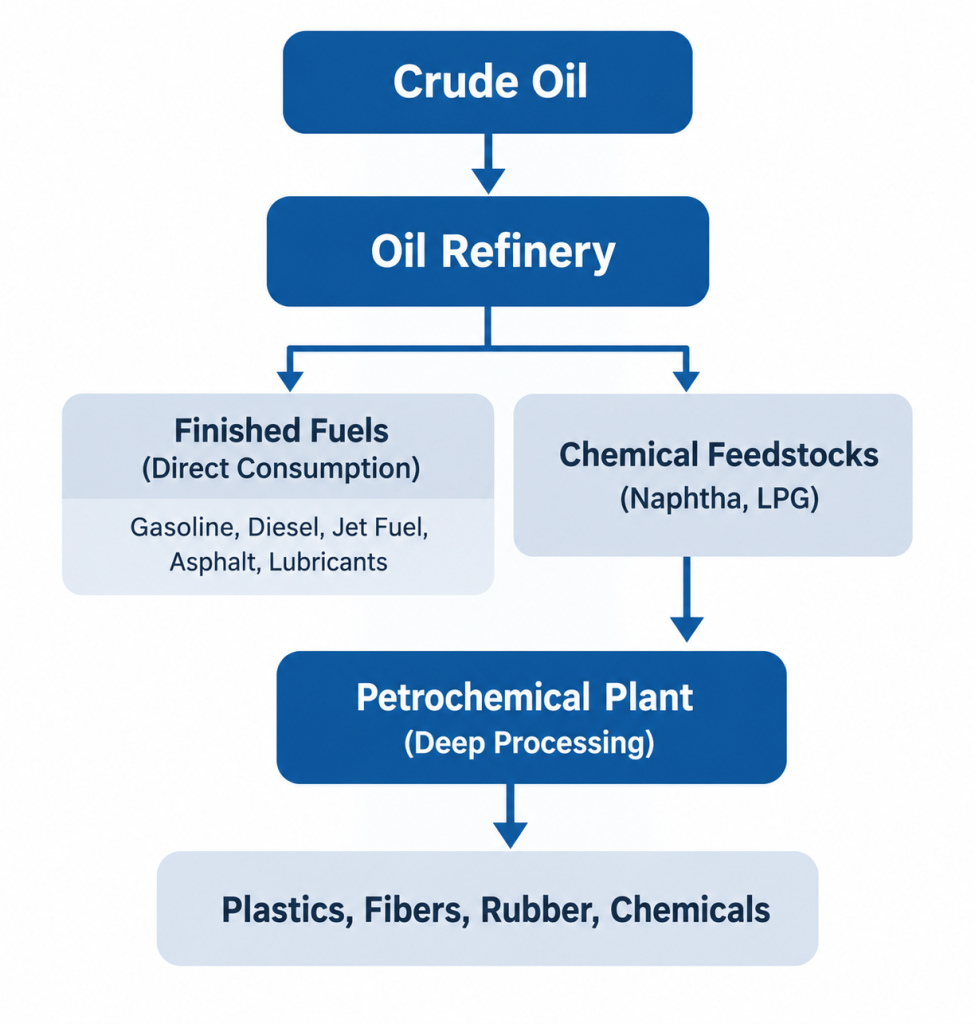
Oil Refinery (Upstream/Midstream):
Role: Acts like a butcher shop. It cuts the whole animal (crude oil) into basic parts: steaks, ribs, and bones (gasoline, diesel, LPG).
Focus: Fuels and energy for burning.
Petrochemical Plant (Downstream):
Role: Similar to a food processing factory. It takes specific cuts or byproducts provided by the butcher (like base gases) and processes them into hot dogs, canned goods, or sausage casings.
Focus: Materials—converting chemical gases into plastics, synthetic rubber, polyester apparel, and detergent bases.
Is a Waste Recycling Plant a “Refinery”?
Is a plant that recycles used engine oil or kitchen grease also called a “refinery”? Strictly speaking, no.
Although these processes use heat or chemical treatments to process liquid oils, their raw materials and purposes are completely different:
| Facility Type | Raw Material (Where does it come from?) | Main Output (What does it produce?) | Industry Term |
| Traditional Refinery | Fossil crude oil (from underground) | Gasoline, diesel, jet fuel, asphalt | Petroleum Refinery |
| Waste Engine Oil Recycling | Used engine oil / industrial lubricants | Re-refined base oil, low-grade fuel oil | Used Oil Re-refinery / Distillation Plant |
| UCO to Biodiesel | Used cooking oil (UCO / kitchen grease) | Green biodiesel, Sustainable Aviation Fuel (SAF) | Biodiesel Plant / Biofuel Facility |