How Is Waste Oil Recycled in an Industrial Plant?

Author: Mr. JAY
Senior Petrochemical & Used Oil Recycling Engineer
With practical experience in used oil recycling systems, fuel recovery routes, and industrial optimization, he focuses on converting waste hydrocarbon streams into cleaner and more valuable products.
The industrial waste oil recycling and utilization process involves raw material pretreatment, separation, and product refining. Depending on the type of raw material and the target product, the processing equipment can be designed to recover and regenerate base oil or to produce diesel-range fuel products. Although these process routes may overlap at the pretreatment stage, their core processing technologies and quality requirements are different.
The Industrial Waste Oil Recycling Process at a Glance
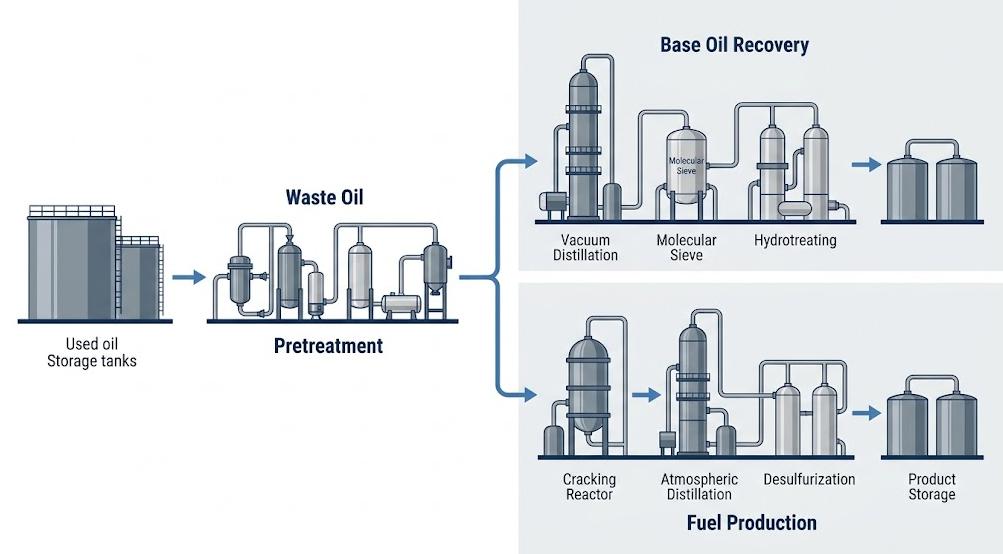
A typical waste oil recycling plant first conducts feedstock inspection, filtration, and pretreatment. Subsequently, the pretreated oil flows into one of the following two main processing routes:
– Base oil recovery: This involves dehydration, distillation, separation of base oil fractions, and further refining where necessary.
– Fuel production: This includes distillation and, where required by the process design, catalytic conversion, fractionation, and fuel refining.
The specific equipment configuration depends on the nature of the feedstock, processing capacity, and target product specifications.
Common Pretreatment Steps Before Recycling
Waste oil may contain water, sludge, solid particles, and degradation products. Testing the feedstock helps determine the appropriate pretreatment methods and subsequent processing procedures.
Storage, settling, and filtration can help remove free water and solid impurities from waste oil. Dehydration and light-ends removal may then be used to prepare the oil for subsequent high-temperature processing.
These steps help support stable plant operation. However, pretreatment alone cannot produce finished base oil or specification-compliant diesel. The subsequent separation and refining processes depend on the selected process route.
Route 1 — Waste Oil to Regenerated Base Oil
During base oil recovery, the aim is to separate useful lubricating-oil fractions and refine them to meet the intended product specifications.
Distillation and Base Oil Recovery
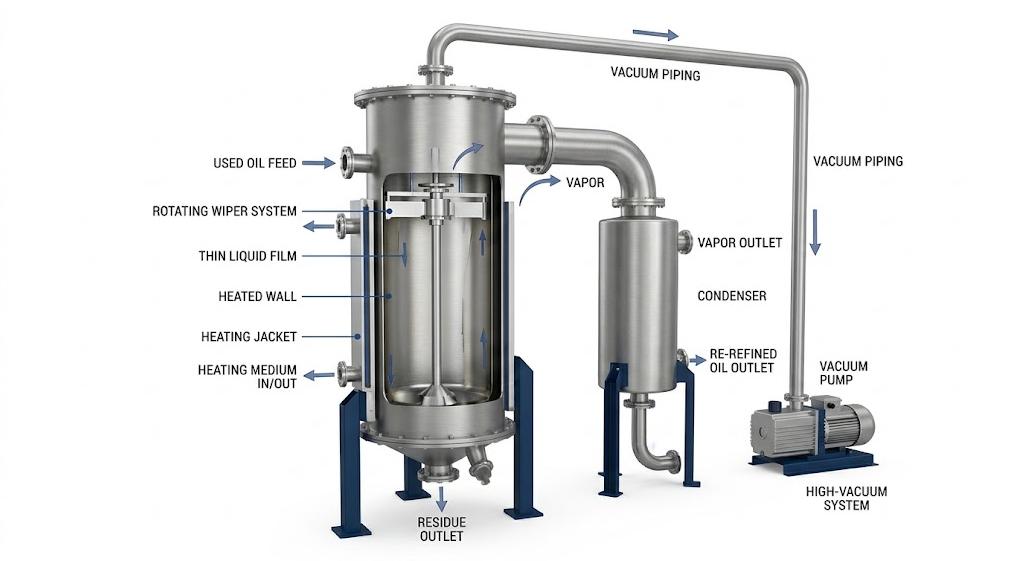
After pretreatment, the oil enters the main distillation section. Vacuum distillation enables component separation under reduced pressure. High-vacuum thin-film distillation is another possible process configuration; it uses a thin liquid film to promote heat transfer and shorten the material’s thermal residence time.
The choice of equipment depends on feedstock characteristics, operating conditions, and product quality requirements. The distillates obtained during recovery are condensed and separated according to their boiling ranges.
Explore the waste oil-to-base-oil process for more information about process selection and engineering considerations.
Further Refining and Quality Control
Distillation alone may not meet the quality requirements for finished base oil. Depending on the target specifications, subsequent treatment may include adsorbent treatment, solvent extraction, or hydrofinishing, where required by the process design.
The recovered oil should be filtered before storage and tested against relevant product specifications. The refining route should be determined by the intended application rather than assuming that every plant uses the same processing sequence.
For more information about this process route, see the Waste Oil to Base Oil Plant page.
Route 2 — Waste Oil to Fuel Products
A waste oil-to-diesel plant follows a different process route because its goal is to recover fuel-range products rather than finished base oil.
Conversion and Fractionation
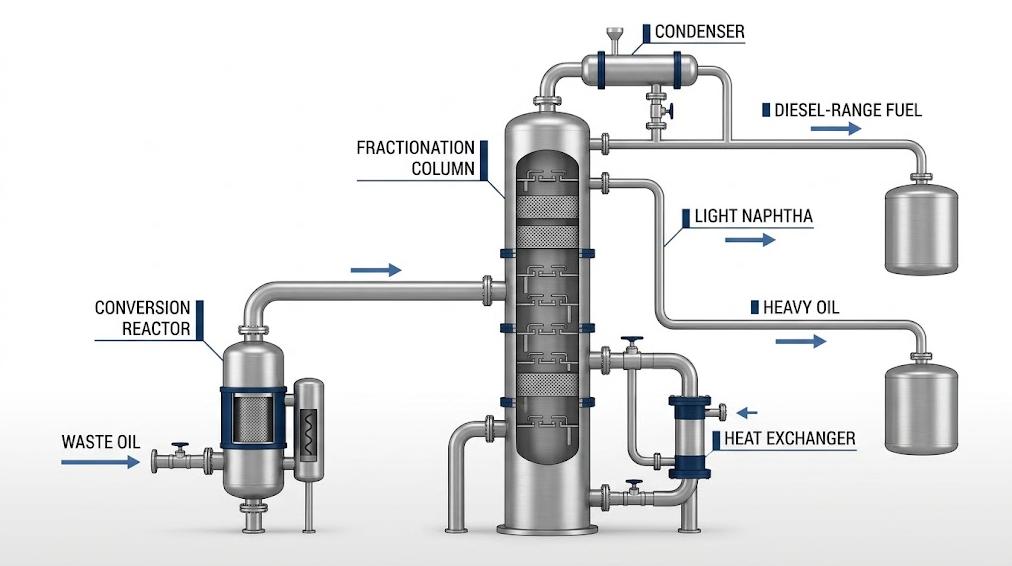
After pretreatment and dehydration, the oil enters the processing stages specified by the plant design. Depending on the selected technology and feedstock, the process may include catalytic conversion followed by fractionation.
Fractionation separates the target diesel-range fraction from lighter components. Depending on the plant configuration and operating requirements, some lighter components may be used as process fuel.
Fuel Refining and Product Testing
The recovered diesel-range fraction may require further refining to meet the intended specifications. The treatment system depends on the target product; different fuel specifications may require different configurations, including desulfurization where applicable.
The final product must be tested against the relevant specifications. Without appropriate treatment and quality verification, a diesel-range fraction should not be considered finished road diesel.
For details of this process route, see the Waste Oil to Diesel Plant page.
How Do You Choose the Right Recycling Process?
When selecting equipment, consider the following factors:
- Feedstock: Oil type, moisture content, and impurity levels.
- Target product: Regenerated base oil or diesel-range fuel.
- Capacity: Planned processing volume and operating schedule.
- Product specifications: Intended application and quality requirements.
- Site conditions: Available utilities, space, environmental requirements, and local regulations.
These factors affect process selection, equipment configuration, and overall project design. Assessing the feedstock and target product first helps establish an appropriate technical basis for the plant.
Frequently Asked Questions
Q1: Can all waste oils be processed in the same plant?
Not necessarily. Feedstock characteristics and the intended product affect the process route and equipment requirements. Plant suitability should be evaluated based on the actual feedstock.
Q2: What is the difference between base oil recovery and diesel production?
Base oil recovery focuses on separating and refining lubricating-oil fractions, while diesel production follows a different route that may involve conversion, fractionation, and fuel-specific refining.
Q3: What information is needed when choosing a plant?
Provide the feedstock type, available quantity, planned processing capacity, target product, quality requirements, and project location.
Discuss Your Waste Oil Recycling Project
Provide your feedstock type, planned processing capacity, target product, and project location to our team. We will work with you to explore a suitable process route and equipment configuration.
Learn more about our Waste Oil Recycling Plant and explore available industrial solutions.